

Fix, retest and operate
Evidence packs for auditors
On this page
An evidence pack is a signed zip that shows an auditor a finding was open in one run and is gone in a later collection. Anyone can check it hasn't been changed, without trusting the person who hands it over.
Build an evidence pack
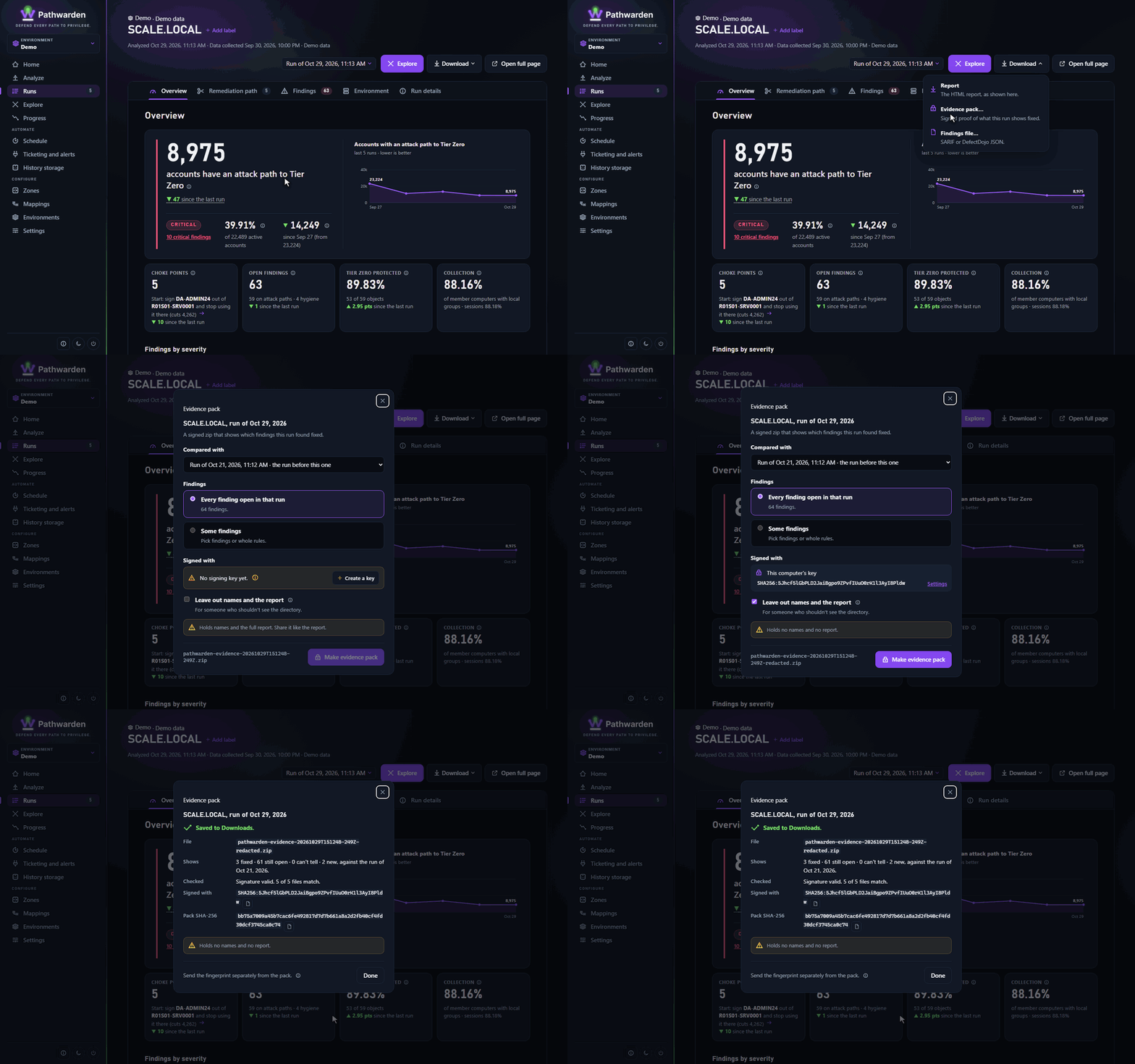
In the app
- Open a run page.
- Click Download › Evidence pack….
The pack compares the run with an earlier run of the same environment. The app signs it with this computer's key; Settings › Evidence signing key shows its fingerprint.
On the command line
# Once: create the key, then publish its fingerprint
pathwarden evidence keygen --output C:\pathwarden\evidence-key

# After the fix: collect again, then build a pack for the finding
pathwarden evidence -i .\collect -c pathwarden.toml `
    --finding PW-003-39f2ede7c479090b --key C:\pathwarden\evidence-key

# Or from runs of the app
pathwarden evidence --run 20261010T083000.123Z --env Demo
pathwarden evidence retests like pathwarden retest, against the run
history or a --baseline, and records nothing. Without --finding or
--rule, it covers every open finding. Its exit status is the retest's,
and it writes the pack even when findings are still open.
More: pathwarden evidence --help.
What is in a pack
| File | Contents |
|---|---|
README.txt | What the pack shows and how to check it. |
metadata.json | Pathwarden's version and both sides of the retest, with the collector files' hashes. |
retest.json | The verdicts, as pathwarden retest --json gives them. |
findings.json | Each finding before and after. |
history.json | The run history since the earliest finding was first seen. |
report.html | The HTML report. Not in a redacted pack. |
manifest.json | The SHA-256 and size of every file, and the signer's public key. |
manifest.json.minisig | The Ed25519 signature of manifest.json. |
A full pack holds names, so share it like the report. --redact leaves out
the report and every object, domain and file name, and Pathwarden refuses to
write a redacted pack in which it still finds one.
Keys
keygen writes evidence.key, the secret key, and evidence.pub, the
public key. Only the current account can read the folder. In a pipeline, put
the last line of evidence.key in the PATHWARDEN_EVIDENCE_KEY variable.
keygen prints the key's fingerprint (SHA256: and 43 characters).
Publish it once, outside the pack: in the contract, on your website or in a
signed email. If the key leaks, make a new one and publish its fingerprint.
Verify a pack
In the app
- Click Settings.
- Under Check an evidence pack, upload the zip.
On the command line
pathwarden evidence verify pack.zip --fingerprint SHA256:NSrf3sUN38/MMY7n/4oyfdbfNmH+cYTZiKVry8z3MkAExit status 0 means verified, 1 not verified (each problem is listed), 2 an
error, and 3 intact but with no --fingerprint or --key to check the
signer. scripts/verify_evidence.py makes the same checks with Python 3
alone (python3 -I verify_evidence.py pack.zip --fingerprint SHA256:...).
The signature doesn't prove when the pack was made, or that the collection was complete; can't tell verdicts guard against an incomplete collection.
The format
For anyone writing their own verifier.
Pack. A zip or folder of plain files: exactly the files manifest.json
lists, plus manifest.json and manifest.json.minisig. Names are relative
and /-separated, with no ., .., \, : or empty parts, each once.
manifest.json (UTF-8):
{
  "schema": "pathwarden.evidence.v1",
  "created_at": 1791621000,
  "created": "2026-10-10T08:30:00Z",
  "pathwarden": "0.1.0",
  "redacted": false,
  "signer": {
    "algorithm": "ed25519 (minisign legacy \"Ed\")",
    "public_key": "RWQ1Kt/exQ3fz0xH...",
    "fingerprint": "SHA256:NSrf3sUN38/MMY7n/4oyfdbfNmH+cYTZiKVry8z3MkA"
  },
  "summary": { "baseline": {}, "after": {}, "counts": {}, "verdicts": [], "selection": {} },
  "files": [
    { "path": "retest.json", "sha256": "<64 lowercase hex>", "bytes": 5178 }
  ]
}
Public key. Base64 (standard, padded) of 42 bytes: "Ed" (0x45 0x64),
an 8-byte key ID (the first 8 bytes of SHA-256 of the public key) and the
32-byte Ed25519 public key. The .pub file is untrusted comment: <text>
and then that base64.
Fingerprint. SHA256: and the unpadded base64 of SHA-256 of the 32-byte
public key.
manifest.json.minisig, exactly four lines, each ending in \n:
untrusted comment: signature from Pathwarden evidence key <fingerprint>
<base64 of "Ed" ‖ key ID (8 bytes) ‖ Ed25519 signature of manifest.json (64 bytes)>
trusted comment: <comment>
<base64 of the Ed25519 signature of (the 64-byte signature ‖ the comment's UTF-8 bytes)>
Both are plain Ed25519 (RFC 8032) signatures by the same key: minisign's legacy format.
To verify:
- Take the publisher's key, or the manifest's
signer.public_keychecked against the published fingerprint. - Check that the signature's key ID is the key's, then both signatures.
- Check that the signature file equals the four lines rebuilt from its parts.
- Check each listed file's SHA-256 and size, and that no other file is in the pack.
- For a
.zip, check that each file's own (local) header gives the same name, flags, method, CRC and sizes as the zip's directory, and that the files sit end to end from the start of the zip to its directory. Otherwise another zip tool could show other files than the ones you checked.
Generated from docs/evidence.md in the Pathwarden repository, version 1.0.0-rc.1.